Getting Wrecked Never Felt This Good: The Science Behind Loving Your Losses
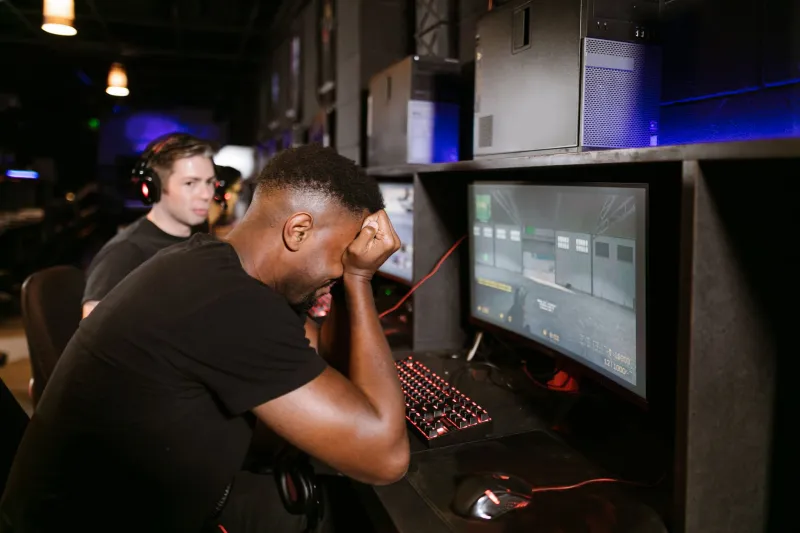
Let's be honest. We've all been there — controller on the couch, maybe a little harder than intended, muttering something colorful under our breath after getting absolutely dismantled by a boss for the fourteenth time. Rage quitting is practically a rite of passage in gaming culture. But something has shifted in the last few years, and if you've been paying attention, you've probably felt it without being able to name it.
The best action games today don't just tolerate your failure. They've engineered it to feel good.
Death Used to Be a Punishment. Now It's Part of the Story.
For a long time, dying in a game was purely transactional humiliation. You messed up, you got sent back, you lost progress. The message was clear: you weren't good enough, go sit in the corner and think about what you did. Early arcade design was literally built around this model — drain the quarters, punish the player, keep the cycle going.
But somewhere along the way, designers started asking a different question. Instead of how do we stop players from failing, they started asking how do we make failing worth sticking around for.
Games like Hades flipped the script entirely. Every death in that game pushes the narrative forward. Characters react to your return. New dialogue unlocks. The underworld itself evolves. You're not just getting another shot — you're continuing a story that literally cannot progress unless you die. Defeat becomes a plot device, and suddenly the sting of getting clipped by a Fury for the dozenth time is replaced by genuine curiosity about what comes next.
That's not an accident. That's intentional design at a level most people don't stop to appreciate.
The Feel of Falling: Why Animation Matters More Than You Think
Here's something that doesn't get talked about enough: the way a character dies matters almost as much as the fact that they died.
Think about the difference between a clunky, stuttery death screen that freezes your character mid-frame versus a fluid, almost cinematic knockdown that sends your fighter skidding across the floor in a way that somehow looks cool. One makes you feel cheated. The other makes you feel like you were part of something.
Action games that nail their knockback physics and death animations are doing psychological heavy lifting. When your character hits the ground with weight and personality — when the dust settles in a way that almost looks like a movie moment — your brain processes that differently than a hard stop. You're not interrupted. You're given a beat to breathe, to replay what just happened, to almost appreciate the move that got you.
Fighting game communities have understood this forever. Getting combo'd into oblivion by someone who clearly put in the lab time is frustrating, sure, but there's a grudging respect baked into watching a clean sequence play out. The animation sells it. The impact sells it. And weirdly, it makes you want to come back and do that to someone else.
Instant Respawns and the Rhythm of Redemption
Friction is the enemy of momentum. Nothing kills the drive to retry faster than sitting through a thirty-second loading screen, a long death cutscene, or menus that make you confirm three times that yes, you do want to try again, thank you very much.
The games that have figured out the respawn loop treat it like a rhythm. You die, you're back in seconds, you're already moving. There's no time for the frustration to calcify into apathy. The window between failure and the next attempt is so tight that your brain is already problem-solving before the emotion has a chance to fully land.
Celeste is a masterclass in this. The respawn is nearly instantaneous. The levels are short enough that failure never costs you much real time. The result is a game where dying hundreds of times — and yes, you will die hundreds of times — never once feels like a grind. It feels like practice. Like you're actively getting better in real time, and the proof is that you keep going.
That's the loop designers are chasing: failure that teaches fast enough to feel like progress.
Reframing the Narrative Around the Player, Not the Win
There's also a storytelling element here that's worth unpacking. A lot of older games treated the player character as an unstoppable force of nature — the hero who will succeed because that's the story. Death was a rupture in that narrative. It didn't make sense. You had to pretend it didn't happen.
Newer action games are increasingly building worlds where failure is woven into the fabric of the character's identity. Roguelikes and roguelites have normalized this completely — your character is expected to fall, to learn, to come back stronger. But even outside that genre, you're seeing it more and more.
Soulsborne games made an entire philosophy out of it. The world is hostile, your character is fragile, and death is not a bug in the experience — it's the texture of it. Players don't just accept dying in those games; they talk about their deaths like war stories. "I got to Malenia on my third character and she absolutely cooked me for two weeks straight" is a sentence people say with pride.
That cultural shift — from death as shame to death as shared experience — is enormous. And it's driven almost entirely by how these games frame the act of losing.
What Players Actually Say About It
Spend any time in action game communities online — Reddit threads, Discord servers, Twitch chats — and you'll notice something interesting. Players aren't just tolerating their losses. They're bonding over them.
There's a whole vocabulary built around it: "skill issue" (affectionate), "touch grass" (when someone's been grinding too hard), "git gud" (the original, lovingly chaotic rallying cry). These phrases exist because the community has collectively decided that struggle is part of the experience, not a detour from it.
When a game makes losing feel like it belongs to you — like your specific, messy, chaotic run through a level is a story worth telling — players stop resenting the difficulty and start owning it.
The Takeaway: Losing Is the Feature
The games that are getting this right aren't making things easier. They're making failure more legible. They're giving you the tools to understand what went wrong, the momentum to try again immediately, and the narrative context to feel like each attempt is meaningful.
That's the real unlock. Not lowering the bar, but redesigning what it means to not clear it yet.
So the next time you get absolutely destroyed by a boss, take a second before you put the controller down. Notice how the game handled that moment. Did it feel like a wall, or did it feel like a door?
Because the best action games out there? They've been building doors this whole time. You just have to keep walking through them.