Why You Keep Hitting Restart at 2 AM: The Dark Psychology of Unputdownable Action Games

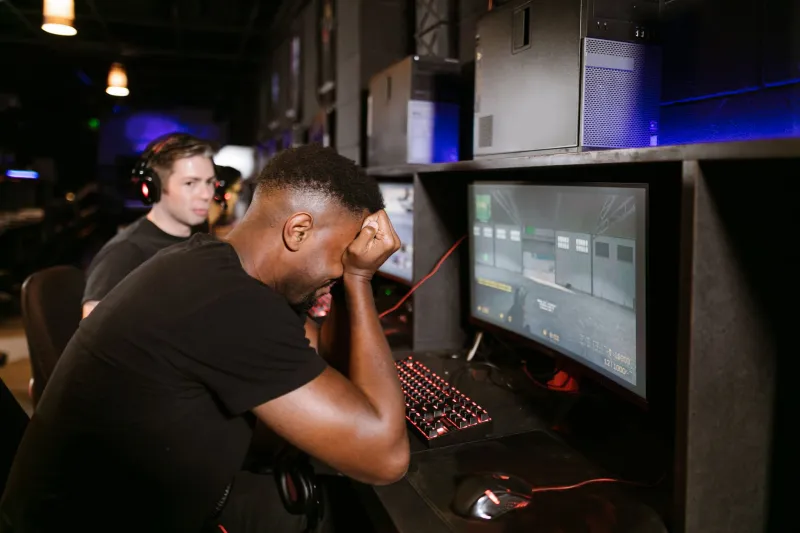
It's 2:17 AM. You just got absolutely destroyed by the same mini-boss for the fourteenth time. Your thumbs hurt. Your eyes are sandpaper. You have work in the morning. And yet — your finger is already hovering over the restart button.
If you've ever lived that moment, you already know there's something different happening in certain action games. Something that separates the ones you uninstall in a cold fury from the ones that eat your entire weekend whole. That difference isn't random. It's engineered, carefully and deliberately, by developers who understand human psychology better than most people give them credit for.
So what's actually going on inside your brain when a game makes you love hating it?
The Line Between Rage-Quit and Restart
Frustration, on its own, isn't the enemy. Cognitive scientists have long distinguished between hopeless frustration — the kind that makes you feel stupid and powerless — and motivated frustration, which actually fires up your drive to try again. The best action games live entirely in that second category.
Dr. Loretta Brewer, a behavioral neuroscientist who studies reward systems and interactive media, puts it plainly: "When a player fails in a way that feels fair, the brain doesn't register defeat — it registers an incomplete task. And incomplete tasks are neurologically uncomfortable. The brain wants resolution. It will push you to go back and finish what you started."
That's the restart loop in a nutshell. The game didn't beat you — it left you with unfinished business.
The games that make you quit for good do the opposite. They create failure states that feel arbitrary, random, or punishing in ways that don't connect back to player skill. When you die because the camera clipped through a wall, or because hitboxes were visibly wrong, the brain doesn't file that under "incomplete task." It files it under "this is broken and not worth my time."
Enemy Design Is Doing More Work Than You Think
One of the most underrated tools in an action game developer's kit is enemy behavior — specifically, how readable that behavior is under pressure.
Marcus Delray, a solo developer behind the 2023 indie breakout Shatter Protocol, spent over a year reworking his enemy AI after playtesting revealed players were quitting during his game's third chapter at an alarming rate. "People weren't quitting because it was too hard," he told us. "They were quitting because they couldn't read what was killing them. Once I added clear wind-up animations and audio cues for every attack, the quit rate dropped by almost 60 percent. Same difficulty. Totally different experience."
This is the invisible craft behind great action game enemies. Players can handle being beaten by something powerful. What they can't handle — psychologically — is being beaten by something they didn't understand. Clarity isn't hand-holding. Clarity is respect. It tells the player: you can learn this. You can beat this. Try again.
Legendary examples like Dark Souls built entire reputations on exactly this principle. Every boss in that game is brutal, but every boss is also legible. Once you die enough times, you start to see the patterns. And that moment of recognition — when the chaos suddenly starts to make sense — is one of the most satisfying feelings gaming has to offer.
Feedback Loops and the Dopamine Drip
Here's where game design gets genuinely sneaky. The best action games don't just reward success — they reward progress toward success in ways that keep dopamine trickling even through losing streaks.
Small things matter enormously here. Getting a little further than last time. Dealing more damage before dying. Finally dodging that one attack that's been wrecking you for six runs. These micro-victories register as genuine wins in the brain's reward circuitry, even when the overall run ends in failure. You're losing, technically. But you're also winning, constantly, in smaller increments.
This is why games with strong roguelite structures — think Hades, Dead Cells, Risk of Rain 2 — are so ruthlessly effective at keeping players hooked through hundreds of failed runs. Every run teaches you something. Every run makes you slightly stronger or slightly smarter. The failure is real, but it's never wasted.
Independent studio Hollow Thread Games, currently in early access with their action-roguelite Fracture Chain, has been vocal about designing what they call "consolation momentum" — the idea that every run should leave the player feeling like they gained something, even if they didn't win. "We track what players are learning, not just what they're achieving," said lead designer Priya Anand. "If we see players consistently dying at the same point without improvement, that's on us, not them. We're not giving them enough information to grow."
Difficulty Curves That Pull Instead of Push
There's a massive difference between a difficulty curve that pushes players away and one that pulls them forward. The distinction comes down to pacing and agency.
A difficulty spike that appears without warning — especially early in a game, before players have built confidence — reads as hostile. It says: this game isn't for you. But a difficulty curve that gradually escalates, gives players space to develop muscle memory, and then introduces a genuinely hard challenge? That reads as a dare. And most action game players, deep down, want to answer a dare.
The psychological term for this is scaffolding — building player competence systematically so that by the time the hard stuff arrives, players have the tools to handle it, even if they don't realize it yet. The best action game developers are essentially teaching without ever feeling like teachers.
Retro-inspired indie titles have gotten particularly good at this. Games that lean into classic arcade structures often front-load the fun and back-load the brutality, giving players a taste of what mastery feels like before demanding it in full. By the time the difficulty peaks, players are already invested — emotionally, temporally, and ego-wise. Walking away means admitting defeat to a game you've already put real time into. The sunk cost is real, and great games know how to use it ethically.
The Secret Ingredient: Respect
At the end of the day, the games that transform rage into obsession share one quality above everything else: they respect the player.
They respect your time by making failure fast and restarts frictionless. They respect your intelligence by making their systems learnable and consistent. They respect your agency by ensuring that when you finally clear that boss, it's because you figured it out — not because you got lucky, and not because the game went easy on you.
That respect is what turns a controller-throwing moment into a "one more run" spiral. It's what makes 2 AM feel like a reasonable time to be gaming on a Tuesday. And it's what separates the games you forget from the ones that live in your head rent-free for years.
Next time you hit that restart button on pure instinct, know that a developer somewhere made a hundred small decisions to put you exactly in that moment. And honestly? Respect that. Then go win.